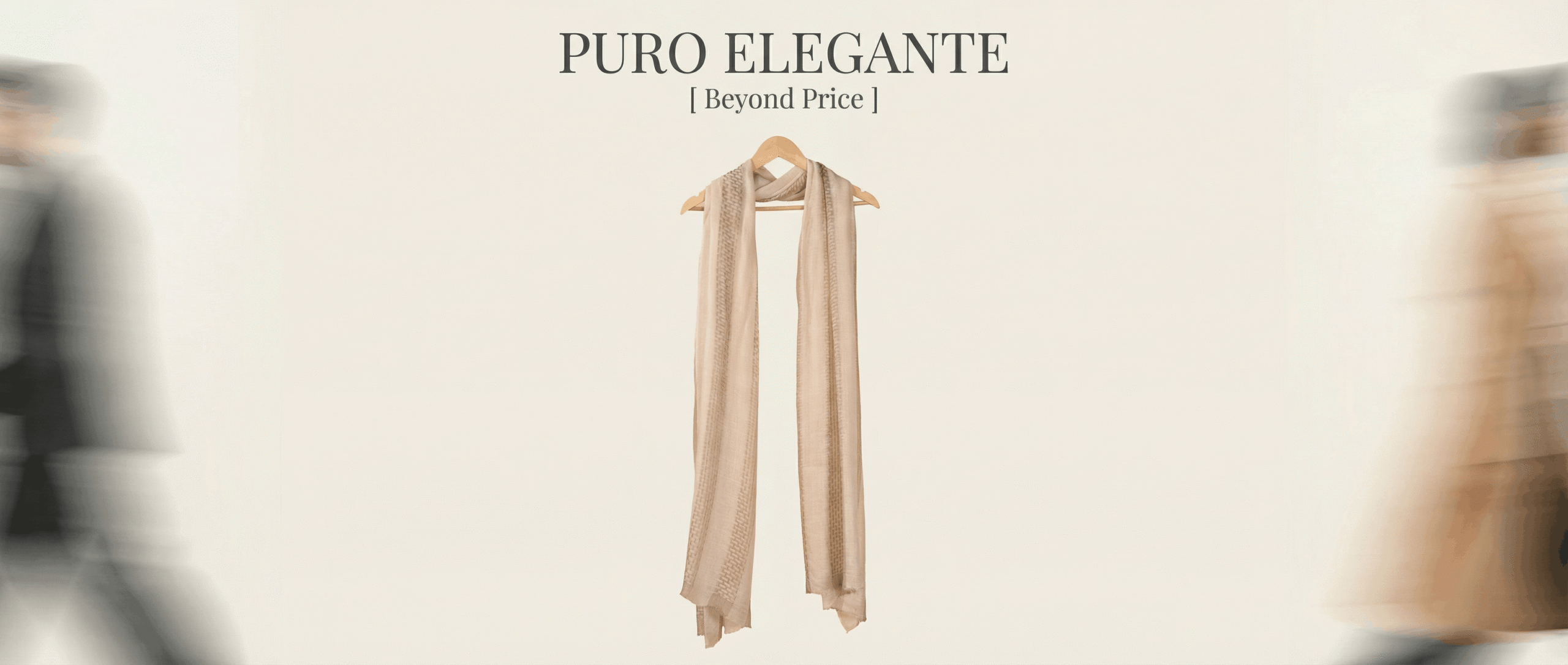
Why high-grade cashmere and pashmina are not defined by cost.
There exists a point at which price stops functioning as a decision-making tool. Not because it becomes irrelevant, but because it becomes insufficient.
In categories such as cashmere scarves and pashmina stoles, price is often used as a shortcut—an assumption that higher cost reflects higher quality. The market has adapted to this assumption. Products are positioned, presented, and priced to meet expectations at the moment of purchase. And in that moment, most succeed.
The surface is soft.
The drape appears correct.
The label reinforces belief.
But time introduces a different evaluation. Over weeks and months, small deviations begin to appear. Structure relaxes beyond intention. The surface loses its uniformity. What once felt precise becomes average. This transition is rarely immediate. It is gradual—and therefore often ignored.
A high-grade pashmina, operating within the finest range of cashmere, behaves differently. It is not engineered to impress initially. It is structured to remain consistent. The fiber retains its character, the weave holds its geometry, and the material resists degradation.
At Puro Elegante, this distinction is not communicated as a feature. It is enforced through the process.
Our fiber is sourced from Changthang, where environmental constraints produce naturally finer cashmere. From there, selection is restrictive. Material that does not meet the required precision is removed early. The objective is not volume—it is integrity.
The result is not a product that justifies its price.
It is one that removes the need to question it.
Read More

Leave a Reply